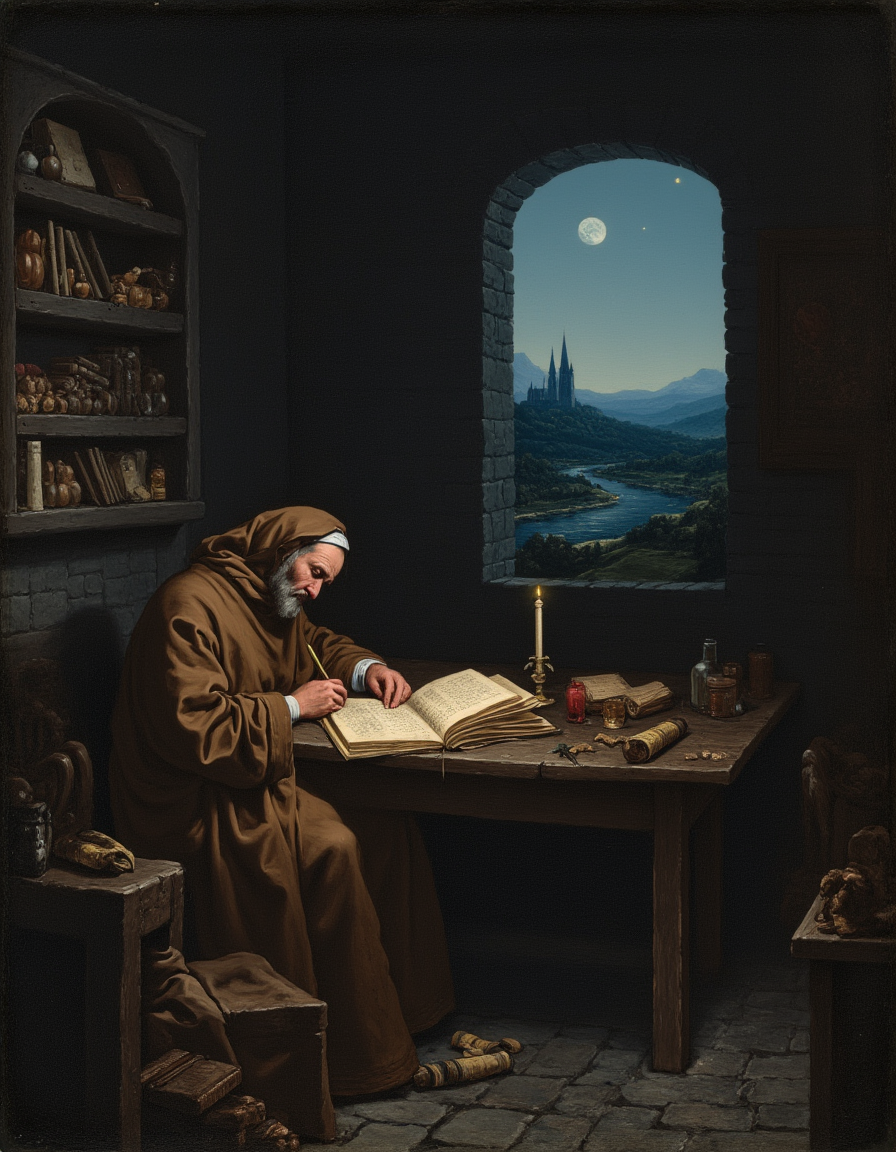
<lora:Flux_-_Renaissance_art_style:1> In a moody, cinematic oil painting, a lone monk sits hunched over a heavy wooden table in the dimly lit chamber of a medieval castle, deep in quiet contemplation. Dressed in a coarse, earth-toned brown wool robe, its simple folds draping over his seated form, he carefully inscribes words into a large, leather-bound manuscript with a quill, the delicate scratching of ink against parchment the only sound in the hushed room. His face, partially obscured by the flickering glow of a single beeswax candle, bears an expression of quiet focusâaged, lined with wisdom, yet softened by the warm light. The small stone chamber is shrouded in deep shadows, its cold gray walls lined with aged wooden shelves, stacked with dusty tomes, rolled parchments, and glass ink bottles. The rough stone floor is strewn with a few scattered pages, some crumpled, some carefully set aside, evidence of long hours spent in scholarly devotion. Behind him, an old wooden stool, slightly uneven from years of wear, creaks softly as he shifts his weight. (A small, narrow window, set high into the thick castle walls,:1.2) allows a faint sliver of moonlight to stream in, casting a cool blue contrast against the golden glow of the candle. Beyond the window, the rolling European countryside stretches out in the misty night, the gentle contours of distant hills and winding roads barely visible under the dim glow of the stars. A lone church spire rises in the far distance, a silent reminder of the world beyond these ancient stone walls. The air is heavy with the scent of melted wax, old parchment, and damp stone, a sensory reflection of the solitude and devotion that define the monkâs world. The scene captures an almost timeless momentâa solitary figure lost in thought, his work illuminated by fragile light, his mind wandering between scripture, philosophy, and the mysteries of the written word.